What’s new

What’s come to Gerok lately, newest first.

  1. Fix the sentence: find the mistake in your own German

    Your story’s sentences come back with one grammar mistake planted in each: a wrong article or ending, the wrong helper verb in the Perfekt, a verb in the wrong form. Tap the word that’s wrong, then choose what goes in its place. It’s put right where it stands, and a line on why goes to your notes. The sentences are made once for your level, when you ask, and then they’re yours to play again.

    Where: On a story’s page, under Practise. Free, and it keeps your streak.
  2. Plural rush: a minute of plurals

    A noun from your stories comes up with its article, and you tap its plural among four: die Kater, die Katers, die Käter or die Katern? It’s a minute against your own best, and five right in a row add three seconds. A miss is put right where it stands, with the pattern it follows: most nouns in ‑er, ‑el and ‑en don’t change, ‑ung, ‑heit and ‑keit take ‑en, foreign words often take ‑s. Right after, another noun of that pattern comes up, so you try it while it’s fresh.

    Where: In Games, from home. Free, and it keeps your streak.

  3. Which case does it take?

    A new game for the prepositions. First you sort them: mit, für, wegen, in… each goes to the case it takes, the accusative, the dative or the genitive, and the two-way ones to Both. Then you use them with the nouns from your own stories: „mit ___ Kollegin“, „Ich bin in ___ Küche“. Tap the article that goes in. With a two-way preposition the verb gives it away: going somewhere takes the accusative, being there the dative. A miss is put right where it stands, with why.

    Where: In Games, from home. Free, and it keeps your streak.

  4. Split the verb: where aufräumen goes in two

    German pulls a verb like aufräumen apart: „Ich räume morgen die Küche auf.“ This game puts your own verbs from every story into everyday sentences, and you tap the two halves into their places. Some sentences keep the verb whole, to show when it doesn’t split: after a modal („Ich muss die Küche aufräumen“), after weil or dass, and in the Perfekt, where ge- goes inside („aufgeräumt“). A slip is put right in the sentence, with the rule that says why.

    Where: In Games, from home. Free, and it keeps your streak.

  5. Build the Perfekt of your own verbs

    Verbs from all your stories now come back as a small game: first choose haben or sein, then the participle among three („aufgeräumt“, „geaufräumt“, „aufgeräumen“). The Perfekt fills in its sentence as you build it, „Ich habe aufgeräumt.“, and the speaker under it says it when you tap. A miss is put right where it stands, with the rule that explains it: sein for a change of place or state, ge- after a separable prefix, no ge- for verbs in -ieren. Missed verbs come back at the end of the round.

    Where: In Games, from home. Free, and it keeps your streak.

  6. A tower of your verbs

    A verb from your stories stands as a tower of six floors, ich at the ground and sie/Sie at the top. Build it from the bottom up by tapping the form each person takes, with one form among them that’s never right („fahrst“). A wrong one bounces back; once the tower stands, each slip is corrected where it was made, with the rule beside it: a → ä in du and er, an -e- after -t and -d, sein and haben as their own. Each tower is a little faster than the one before, against your own best, and the verbs you slipped on lead the next round. Separable verbs keep their other part at the end: ich räume auf.

    Where: In Games, from home. Free, and it keeps your streak.

  7. Im Takt: catch your story’s words on the beat

    Your story now plays in its own German voice as karaoke, and every few seconds a word still to come drops out. Tap it among three before the voice says it: in time, your run grows and the gaps come closer; late or wrong, the word is put right where it stands and the voice goes on. It’s the one game that trains your ear at real speed. New to it? Play it at 0.75×.

    Where: On a story’s page, under Practise. Free, and it keeps your streak.
  8. A word search that asks what a word means

    Words from all your stories now hide in a square of letters: across, down and diagonally, and from B1 backwards too. The list beside it doesn’t give the German, only what each word means, so you think of the word first and then find it: drag across it, or tap its first letter and then its last. A word you find shows with its article, is said aloud and is crossed off. Stuck? The hint lights where it starts, then shows it; for an easier round, switch the list to German.

    Where: In Games, from home. Free, and it keeps your streak.
  9. A scanword of your own words

    Words from all your stories now cross each other in a small Schwedenrätsel. Each clue sits in a square with an arrow, written in simple German at your level („Man trinkt ihn morgens“), and you type the answer: a noun without its article, ß as SS. Right letters stay in green, a finished word is said aloud, and if you’re stuck the hint gives what it means, then a letter, then the word. Every round has a different number of words, and everyday ones fill in while your stories have few.

    Where: In Games, from home. Free, and it keeps your streak.
  10. Levels for the articles sprint

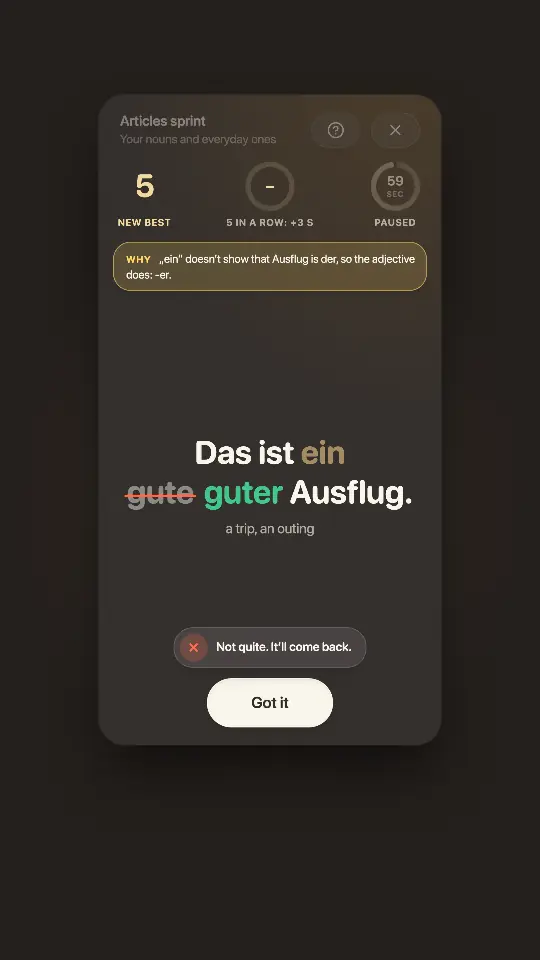
    The sprint has three levels now. Articles is der, die or das, as before. Cases puts your noun in a few words that set its case, and you choose the form of ein it takes: „Ich suche ___ Termin.“ is einen. Endings gives you the article and asks for its adjective’s ending: „mit einem neu__ Termin“ is ‑en. Miss one and the clock waits while Gerok shows why („ein“ doesn’t show that Ausflug is der, so the adjective does: ‑er), and the rule comes back on another noun a moment later, to try while it’s fresh. Each level keeps its own best.

    Where: On home, under Today’s review: choose the level before your first answer. Free, and it keeps your streak.
  11. Grammar finder

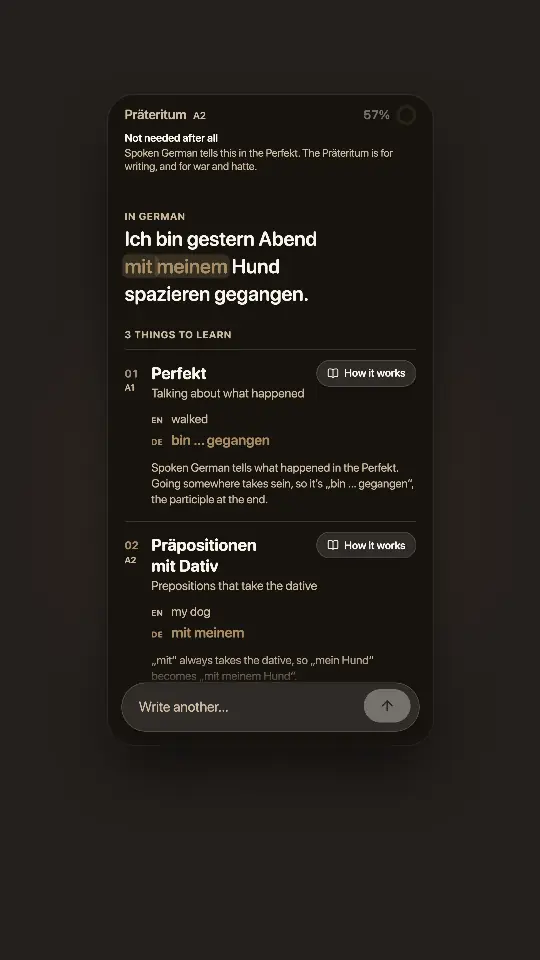
    Write something you want to say, in your own language, and see at once the German grammar it takes: each topic with how likely the German needs it, the main thing to learn first. Ask Gerok to explain, and you get it in German, each topic shown at work in it, lit in your words and in the German, with why. Every topic opens its own guide to how it works.

    Where: On Home, at the foot, under Language Studio: Grammar finder. With Gerok Plus. Nothing you write there is kept.

  12. Hear and type

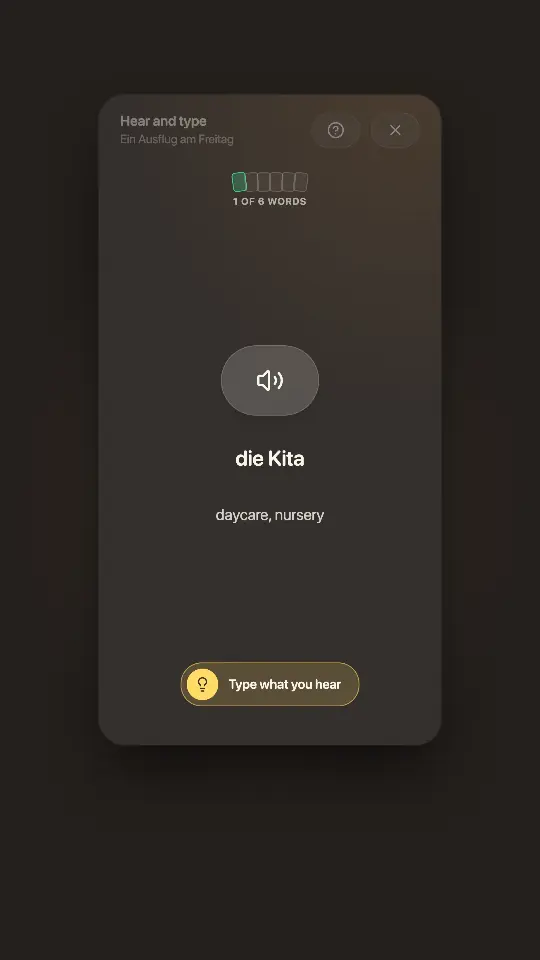
    Your story’s words, each said on its own in a clear German voice, for you to type as you hear them, nouns with their article. Each right letter fills its place, and once a word is typed you see what it means; a word you slipped on comes back at the end. Every word on the Words step, the words page and in Today’s review now has its own pronunciation too, to hear whenever you like.

    Where: On every story’s page, under its path, once its Words step is made. Free.

  13. Type the story

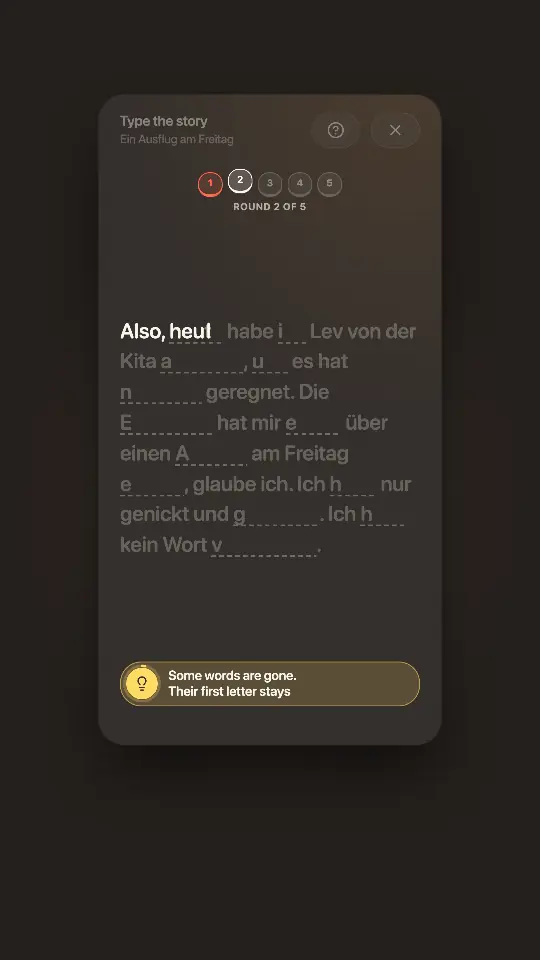
    Learn the start of your story by heart, on the keyboard. Five rounds over the same lines, each with less to lean on: first you type over the faint text, then some words go but their first letter, then those words, then every word but its first letter, and at the end you type it all from memory. A wrong key simply isn’t taken, Tab shows the next letter, and you need no German keys: a, o and u do for ä, ö and ü.

    Where: On every story’s page, under its path, on a computer or a phone. Free.

  14. Friends

    Invite someone you know and take turns telling each other about your days, in German, each in your own voice. What a friend sends comes to you as a story: you learn it at your level, then answer them. Gerok never speaks for you.

    Where: Top right, the antenna beside your profile. With Gerok Plus.

  15. Language Studio

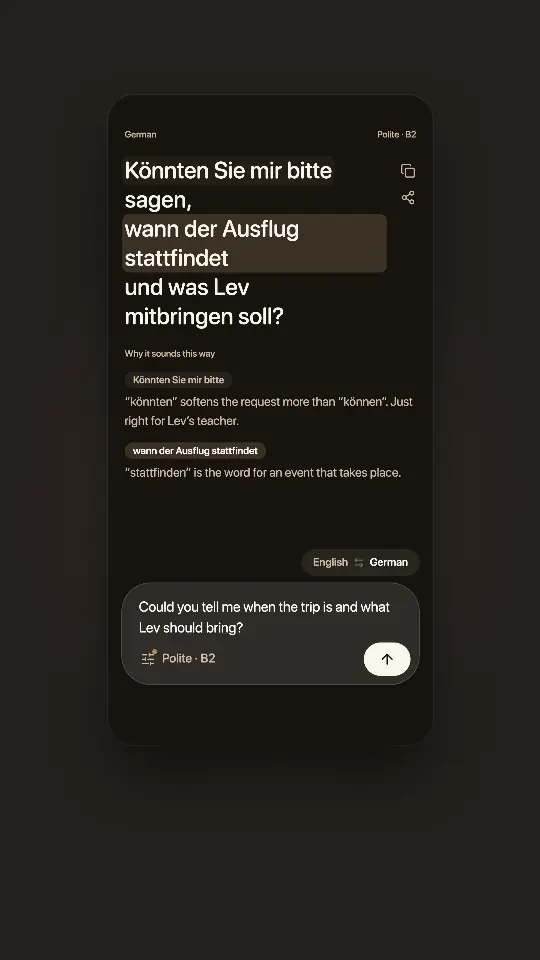
    Write what you want to say in your own language, and Gerok puts it into German the way you ask: friendly or formal, du or Sie, for a message, an email or to say out loud, close to your words or as a German would say it, at the level you choose. It tells you why it sounds that way, and lights the phrase in your sentence each note is about. Paste German instead and it tells you what it means, and which words are worth learning.

    Where: On Home, at the foot: Language Studio. With Gerok Plus. Nothing you write there is kept.

  16. Retell

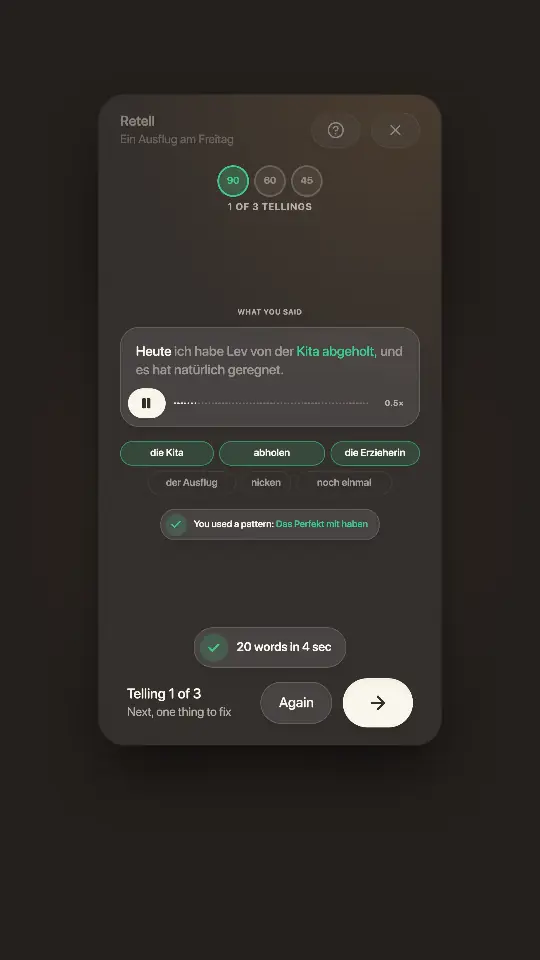
    After Shadowing, tell your story again in German, from memory: three times, each a little shorter (90, then 60, then 45 seconds), so it comes more easily each time. A few of its words lead you through it. Gerok writes down what you said, lights the words and patterns you used, and asks about one thing to put right, in your own words, which you can hear again.

    Where: On every story’s path, between Shadowing and Role-play. Free: each telling counts as one of the day’s role-play answers.

  17. Words in the picture

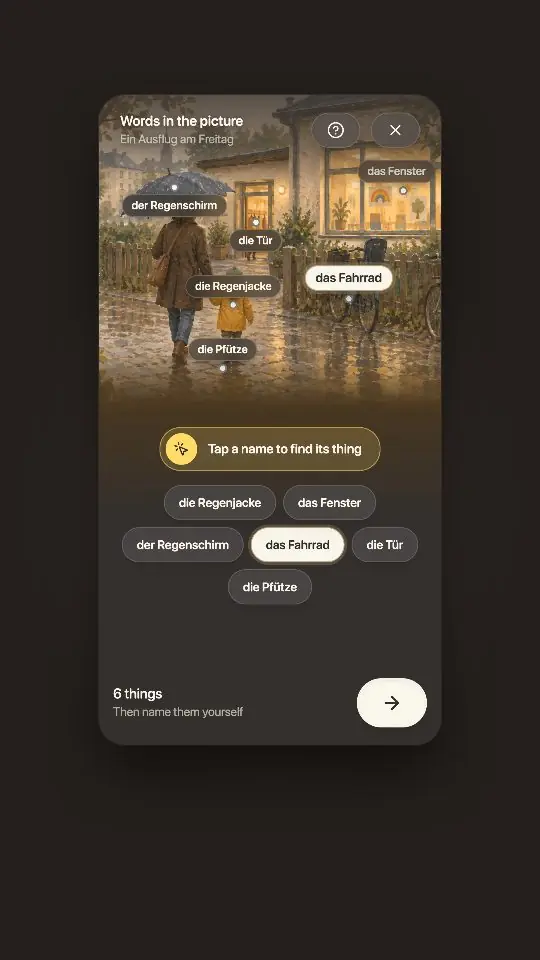
    Gerok paints a scene from your story and pins the everyday things in it with their German names. Take a look first; then the names go, and you give each one back, choosing among four, often with its article. The picture is the meaning, so your own language never comes in between.

    Where: On a story’s page, under its learning path. With Gerok Plus: a scene counts as one of the day’s pictures.

  18. The articles sprint

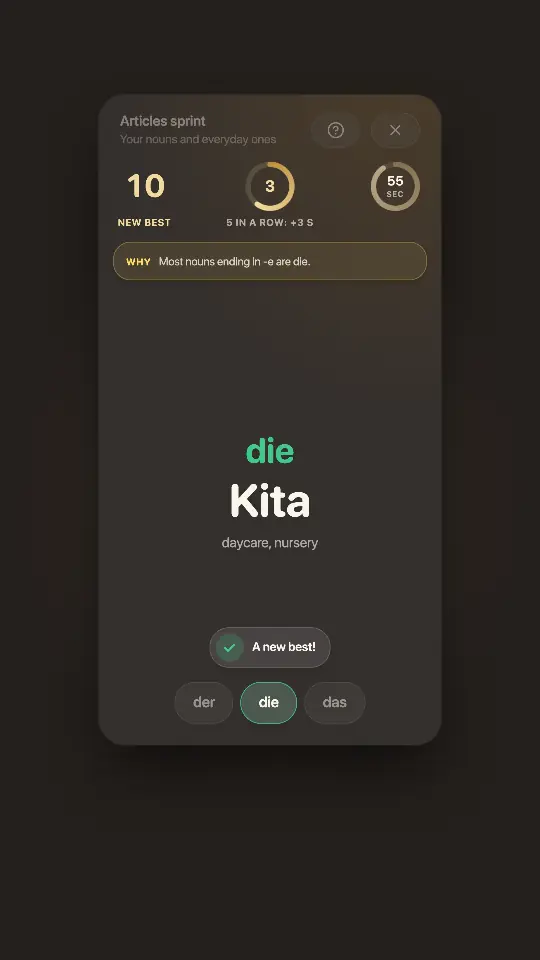
    A minute of der, die or das on the nouns from your Words steps. Five right in a row add three seconds. Miss one and the clock waits while Gerok shows what its ending says (a noun ending in -ung is always die), and the noun comes back a little later. You race only your own best, and the nouns of yours you missed come back in Today’s review.

    Where: On home, under Today’s review. Free, and it keeps your streak.